Research
How does the brain encode and retrieve memories and make inferences?
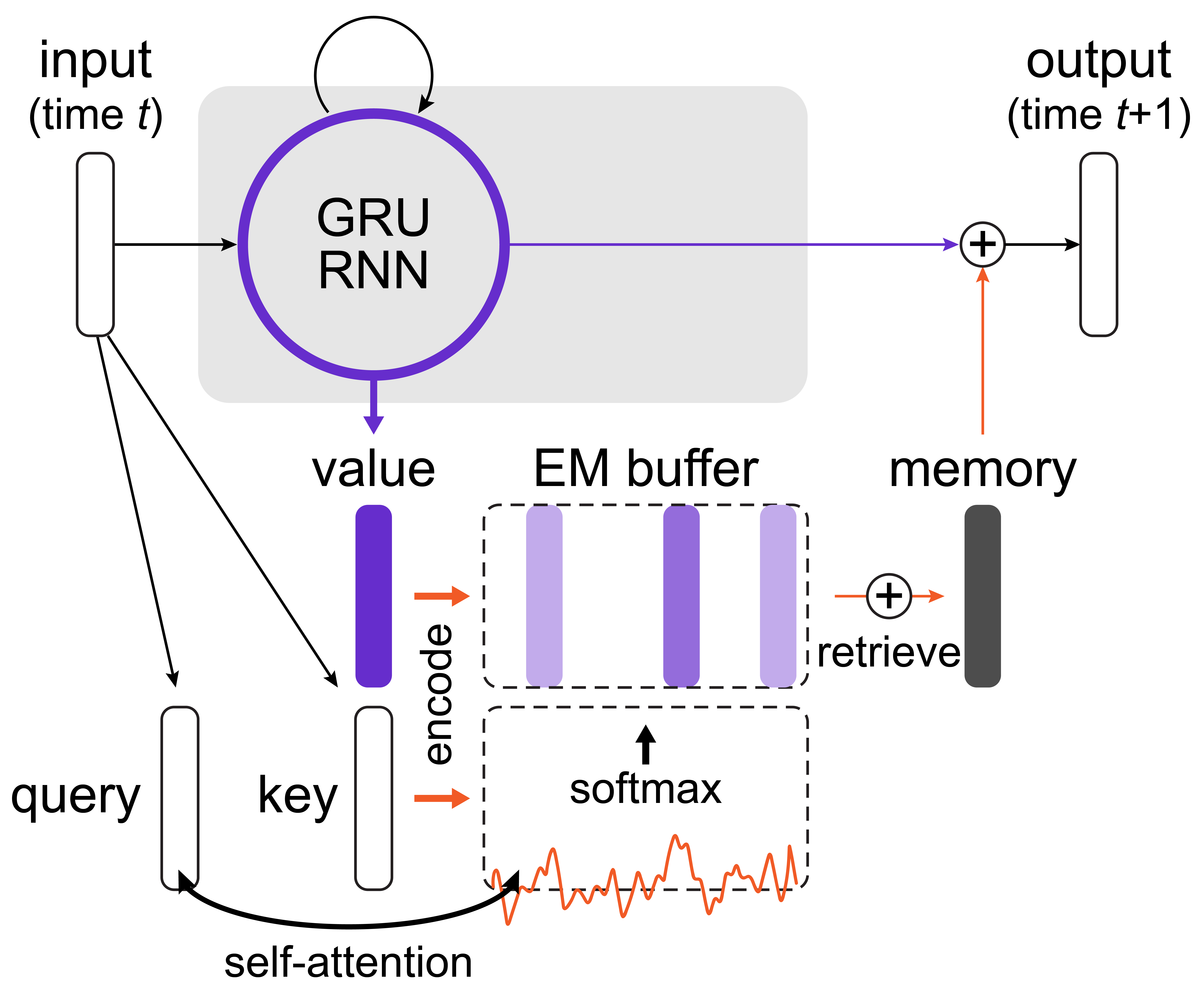
Throughout our lifetime, we continuously encode memories that not only become lasting traces of our unique experiences but also our knowledge about the world. Yet, memory is not simply a record of the past. From countless stored memories, we selectively retrieve those that are most relevant to the present moment, and use them to make inferences and guide future behavior. In the lab, we study the neurobiological and computational mechanisms by which the brain encodes and retrieves memories, and how these processes give rise to higher-order cognition such as reasoning, generalization, and context-dependent behavior. We build computational models of the hippocampus-default mode network circuitry to answer these questions.
- Song, H., Lu, Q., Nguyen, T. T., Chen, J., Leong, Y. C., Rosenberg, M. D., Ching, S., Zacks, J. M. (preprint). A neural network with episodic memory learns causal relationships between narrative events.
- Song, H., Ke, J., Madhogarhia, R., Leong, Y. C., Rosenberg, M. D. (2026). Cortical reinstatement of causally related events sparks narrative insights by updating neural representation patterns. Nature Communications 17, 7362.
- Park, J., Song, H., Shim, W. M. (2025). Hippocampal systems for event encoding and sequencing during ongoing narrative comprehension. Communications Biology 8, 954.
- Song, H., Park, B.-Y., Park, H., Shim, W. M. (2021). Cognitive and neural state dynamics of narrative comprehension. Journal of Neuroscience 41 (43), 8972–8990.
How do people sustain attention but sometimes lose focus and mind-wander?
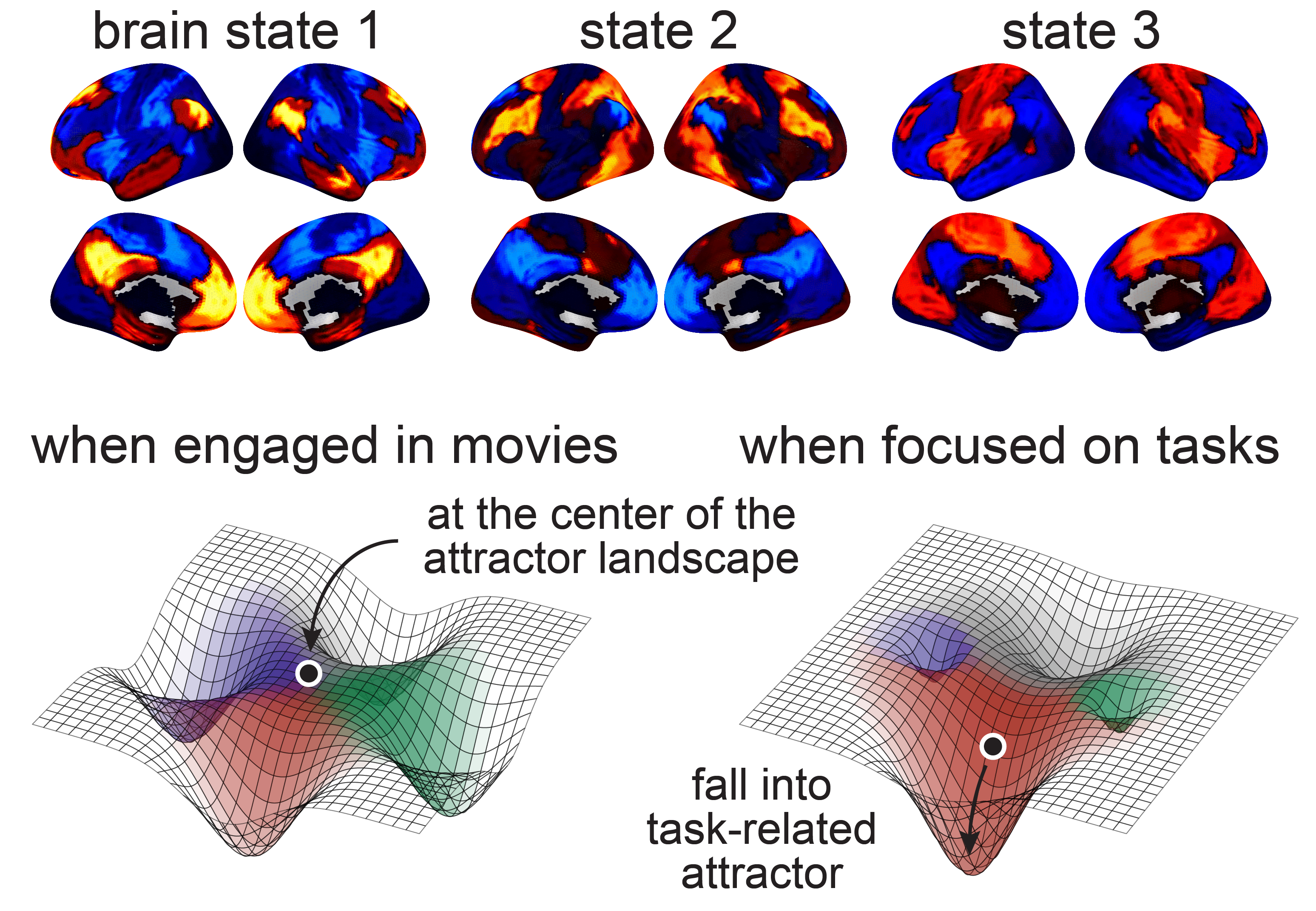
Attention is never constant but continuously waxes and wanes over time. There are moments and situations where we can easily pay attention, but oftentimes we can't help ourselves from losing focus and daydream or simply doze off. Attention not only varies over time but the ability to pay and sustain attention drastically differs across people. Our lab studies how attention changes across time and contexts and differs across individuals. We have shown that attention is reflected in large-scale brain states, and explained its dynamics as a flow within a cortical attractor landscape. We are currently asking how these cortical state dynamics relate to different neuromodulatory systems. We are also testing several hypotheses on why attention-related brain states differ across situations and how they differ in individuals who are more likely to struggle with paying attention.
- Song, H., Chen, R., Botch, T. L., Braver, T. S., Rosenberg, M. D., Zacks, J. M., Ching, S. (2026). Geometry of neural dynamics along the cortical attractor landscape reflects changes in attention. Nature Communications 17, 2673.
- Song, H., Shim, W. M.*, Rosenberg, M. D.* (2023). Large-scale neural dynamics in a shared low-dimensional state space reflect cognitive and attentional dynamics. eLife 12, e85487.
- Song, H., Finn, E. S., Rosenberg, M. D. (2021). Neural signatures of attentional engagement during narratives and its consequences for event memory. Proceedings of the National Academy of Sciences 118 (33), e2021905118.
How does the brain operate across levels of organization to support flexible behavior?
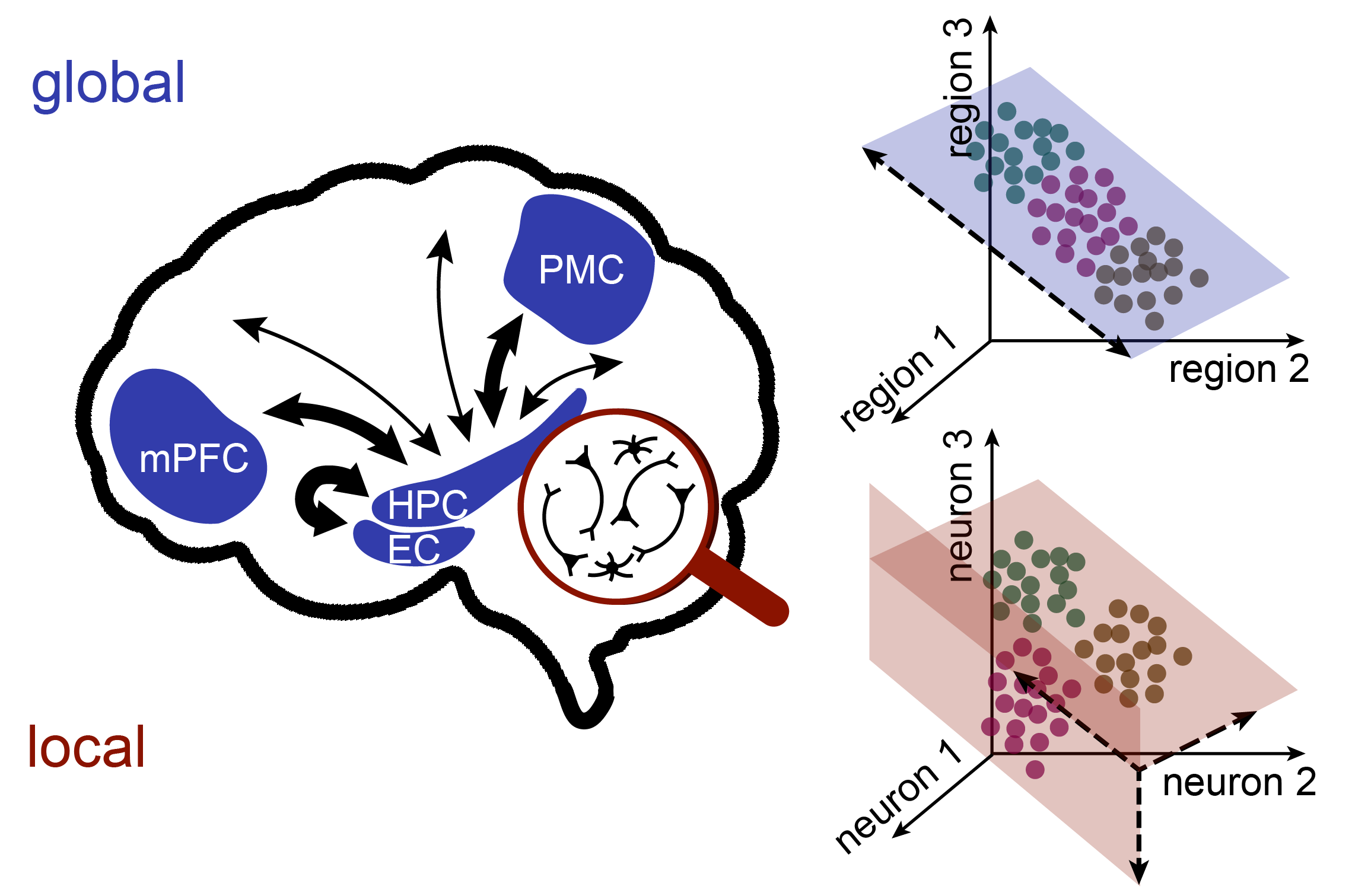
The brain is a multiscale system, with its operations ranging from firing and wiring of neurons to activation and connection of regions and large-scale functional networks. We hypothesize that different cognitive processes emerge from distinct information coding principles across these scales, which collectively give rise to complex behavior. With such a perspective, our lab seeks to understand how cognition emerges from each unique scale and a collection of multiple scales. We value across-lab and across-field collaborations, because answering these questions requires data and models from multiple animal species and neuroscientific techniques.
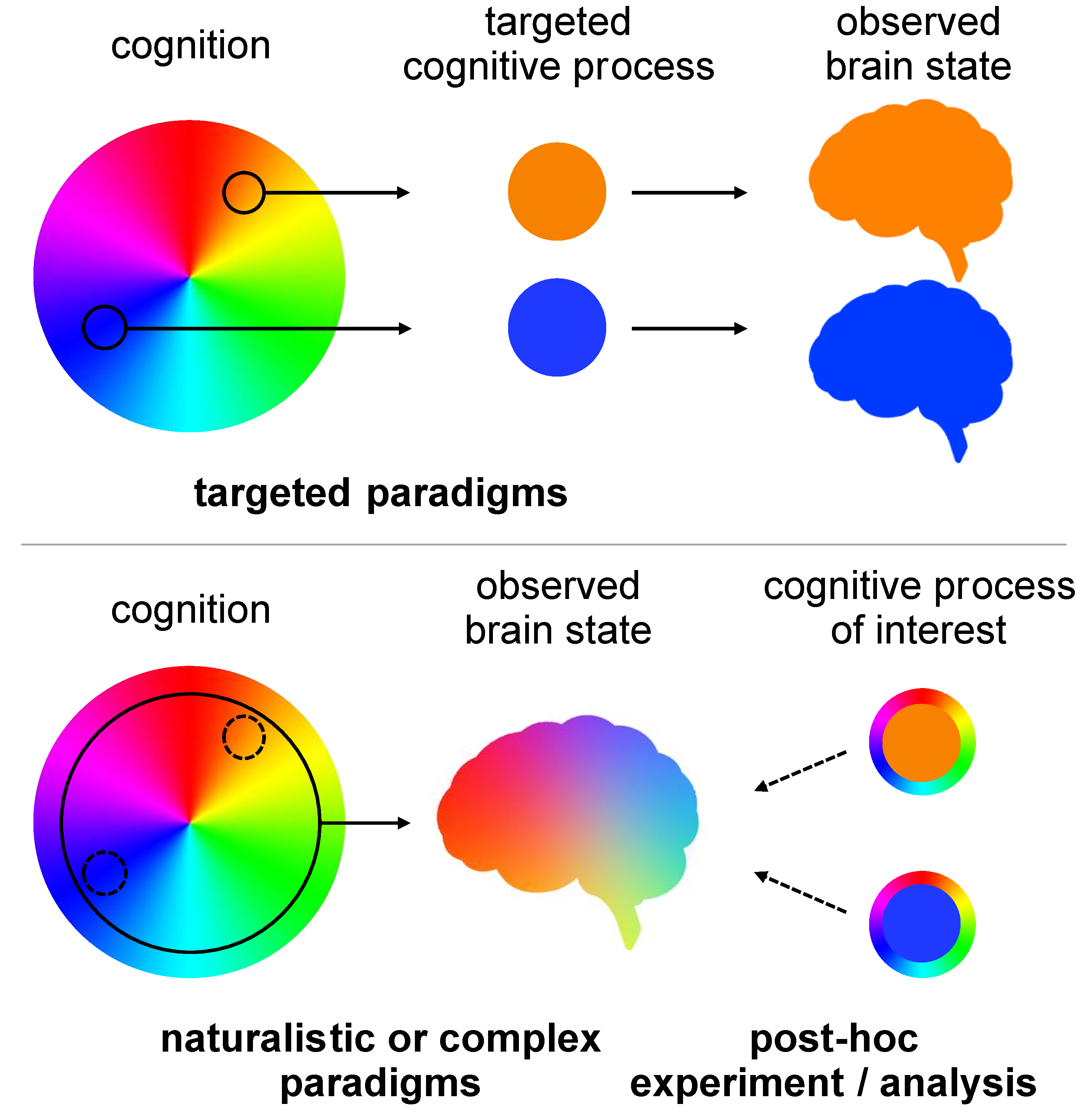
How can we better study cognitive experiences as they unfold in the real world?
Historically, psychological research has relied on well-controlled experiments, segmenting cognitive experiences into distinct parts and isolating a cognitive process of interest while controlling for the rest. However, recent studies are telling us that neural findings obtained from controlled task paradigms differ from those obtained in naturalistic contexts. While our lab values and utilizes controlled tasks, we push the boundaries of neuroscience studies such that fMRI participants watch movies, listen to stories, talk about their thoughts and feelings, play video games, and navigate virtual environments inside the scanner. We also conduct behavioral studies "in the wild" to study cognitive experiences in its whole rather than its parts. Our goal is to understand the mechanisms of cognition in its full complexity without sacrificing ecological validity.